
The history of NCS Colour
Celebrating 80 years
NCS Colour was founded in 1945, marking eight decades of innovation in colour communication.
Over the years, the NCS System has become a fundamental tool in colour communication. Developed by scientists, the system was created to meet the need for a reliable and practical way to define and reproduce colours the way humans perceive them. Today, the NCS System is used globally in design, architecture, coatings and manufacturing industry, setting the standard for colour communication with its accuracy and ease of use. From its early beginnings, the NCS System has grown into a central part of the modern colour world.
Researching the Natural Colour System in the 1920s
- Originators: Colour researcher Anders Hård, psychologist Lars Sivik and physicist Gunnar Tonnquist.
- Foundation: The only colour system based on human perception of colour.
Founding the company NCS Colour in 1945
- Founding year: 1945 as T. Palmer AB
- 2010: Became NCS Colour
Launching the NCS System to the market in 1979
- NCS System Launch: 1979 with the original NCS Atlas including 1,450 NCS Standard colours.
- NCS Standard Colours today: 2,050

Early Initiatives in Swedish Colour Research
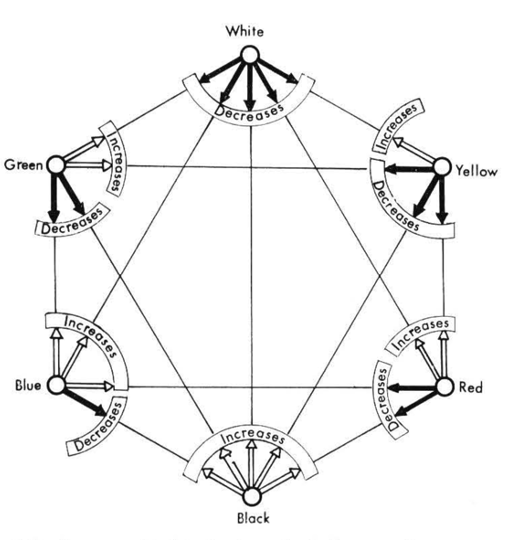
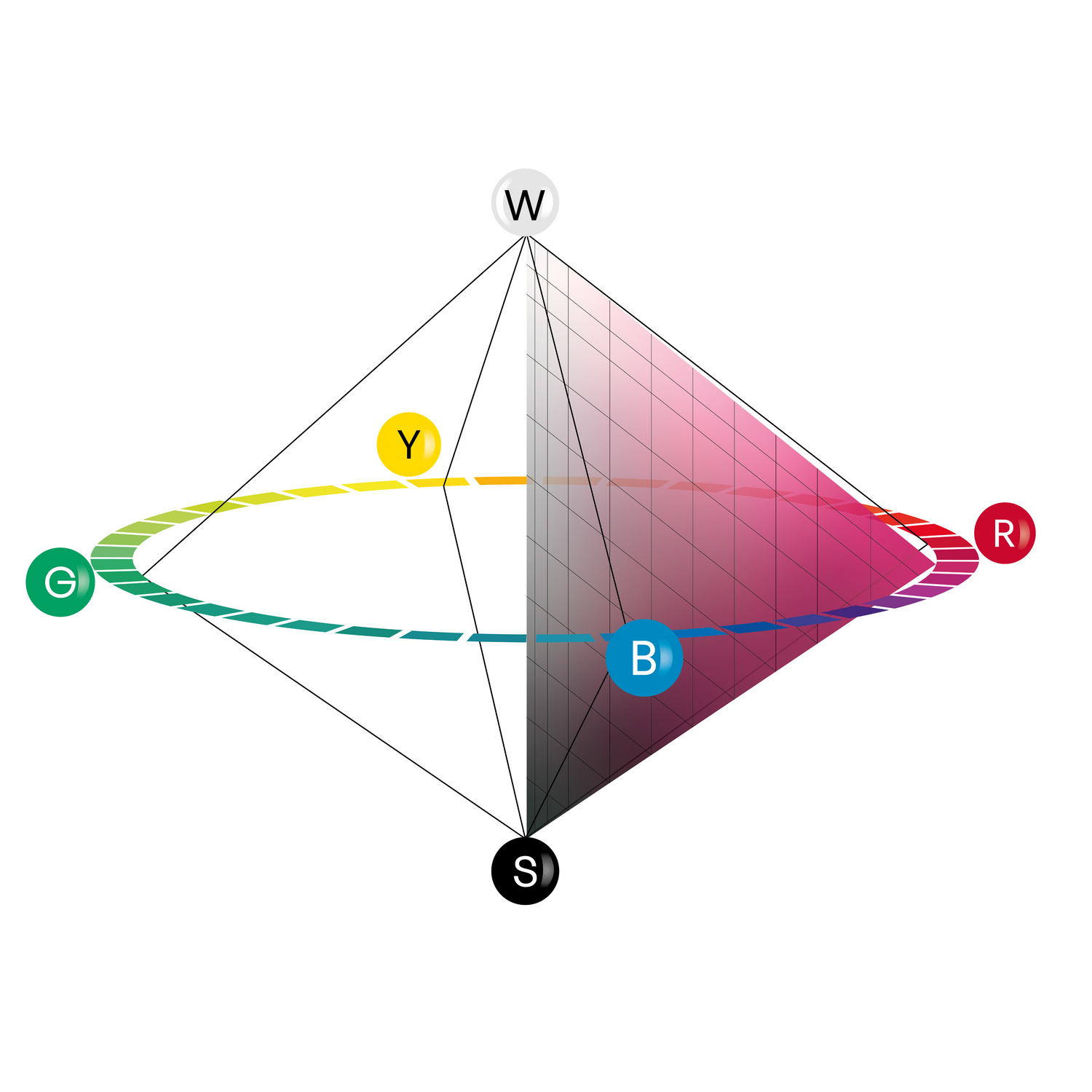
In the 1920s, Swedish researchers set out to create a system grounded in how humans actually perceive colour, rather than how pigments are mixed. Under the leadership of Professor Sven Hesselgren, PhD, a network of international scientists investigated colour relationships, building on Ewald Hering’s opponent-process theory of vision. This work explored the perceptual dimensions of hue, blackness, and chromaticness, aiming for a logical, universally understandable framework for colour description.
The Swedish Society of Crafts and Design (today Svensk Form) began educating the public on colour use in the early 1930s, as advances in manufacturing expanded the available palette. The combination of technological progress and industrial demand intensified the need for a reliable, perception-based colour standard.
Tryggve Johansson and Sven Hesselgren: Pioneers of the Natural Colour System
In the late 1930s, Swedish physician and colour researcher Tryggve Johansson applied Hering’s theory to systematic colour description, developing the conceptual foundation for the Natural Colour System in 1937. Working closely with Hesselgren, he combined perceptual theory with colourimetric testing to create a scientifically rigorous yet practical model. Their shared goal was to bridge the gap between human colour perception and the requirements of design, architecture, and manufacturing, a principle that remains at the heart of NCS Colour today.

Creation of the first colour sample collection
Torsten Palmer, Swedish colour researcher and later co-founder of the Swedish Colour Centre Foundation, and Anders Sjögren, pioneering industrialist in colour production, together with Hesselgren and Johansson, created the first commercial, product-independent colour card collection with 285 colours in 1938: the Hesselgren & Sjögren Colour Sample Collection.
Early Initiatives in Swedish Colour Research
In the 1920s, Swedish researchers set out to create a system grounded in how humans actually perceive colour, rather than how pigments are mixed. Under the leadership of Professor Sven Hesselgren, PhD, a network of international scientists investigated colour relationships, building on Ewald Hering’s opponent-process theory of vision. This work explored the perceptual dimensions of hue, blackness, and chromaticness, aiming for a logical, universally understandable framework for colour description.
The Swedish Society of Crafts and Design (today Svensk Form) began educating the public on colour use in the early 1930s, as advances in manufacturing expanded the available palette. The combination of technological progress and industrial demand intensified the need for a reliable, perception-based colour standard.
Tryggve Johansson and Sven Hesselgren: Pioneers of the Natural Colour System
In the late 1930s, Swedish physician and colour researcher Tryggve Johansson applied Hering’s theory to systematic colour description, developing the conceptual foundation for the Natural Colour System in 1937. Working closely with Hesselgren, he combined perceptual theory with colourimetric testing to create a scientifically rigorous yet practical model. Their shared goal was to bridge the gap between human colour perception and the requirements of design, architecture, and manufacturing, a principle that remains at the heart of NCS Colour today.
Creation of the first colour sample collection
Torsten Palmer, Swedish colour researcher and later co-founder of the Swedish Colour Centre Foundation, and Anders Sjögren, pioneering industrialist in colour production, together with Hesselgren and Johansson, created the first commercial, product-independent colour card collection with 285 colours in 1938: the Hesselgren & Sjögren Colour Sample Collection.


The only true correct definition of colour: Colour is what we see as colour. Colours are created in the psyche, in the very moment we perceive them, and as long as we look at them. It is important in colour science to distinguish between physical colour (physics) and perceptual colour (psychology), what we see as colour.
– Lars Sivik, 1965, co-founder of the Natural Colour System
The only true correct definition of colour: Colour is what we see as colour. Colours are created in the psyche, in the very moment we perceive them, and as long as we look at them. It is important in colour science to distinguish between physical colour (physics) and perceptual colour (psychology), what we see as colour.
– Lars Sivik, 1965, co-founder of the Natural Colour System


The founding of NCS Colour in 1945
Making the Natural Colour System commercially available was an important step towards enabling universal colour communication. In 1945, the company that would later be renamed NCS Colour was founded.
As colour became increasingly available and important in daily life during the 1950s and 1960s, the demand for both research and education grew in parallel. Scientific study provided the knowledge base, while education ensured that designers, architects, and industry professionals could apply this knowledge in practice.
The founding of NCS Colour in 1945
Making the Natural Colour System commercially available was an important step towards enabling universal colour communication. In 1945, the company that would later be renamed NCS Colour was founded.
As colour became increasingly available and important in daily life during the 1950s and 1960s, the demand for both research and education grew in parallel. Scientific study provided the knowledge base, while education ensured that designers, architects, and industry professionals could apply this knowledge in practice.
The first colour reference tool
When the NCS System launched in 1979 with the now-iconic NCS Atlas, it marked a breakthrough: the first and only colour system based entirely on how humans perceive colour.
The long and rigorous research approach ensured that the NCS System could act as a reproducible and universally understood “language of colour” across materials, industries, and cultural contexts.
The first NCS Atlas was a complete, perception-based colour system, presented in a collection of 1,412 precisely defined standard colours, ready for consistent application in design, architecture, manufacturing, and education.
Educating Colour
During the 1950s, the Colour in the Home initiative, developed with IKEA, led Hesselgren and Johansson to create a dedicated colour department. This department launched one of the first commercial colour schools and educational programmes, involving up to 20 designers, and laid the foundations for modern colour expertise.
These early educational activities evolved directly from the same research traditions that drove the development of the Natural Colour System. They became the backbone of what is now the NCS Colour Academy, where the principles discovered through decades of research are still taught and applied worldwide.
Two decades of research and innovation
In the 1960s, the Swedish Colour Centre Foundation set out to transform the Natural Colour System from a theoretical model into a scientifically validated standard. The research was led by Anders Hård (colour researcher), Lars Sivik (psychologist), and Gunnar Tonnquist (physicist).
Together, they combined expertise in perception, physics, and colour measurement to conduct extensive psychophysical experiments, analysing tens of thousands of visual assessments to precisely define the system’s parameters. Nearly two decades of research and refinement resulted in the practical application on the Natural Colour system.
Launching the NCS System in 1979
It must be possible to produce the same colour on different products from different manufacturers. Producing the exact colour is crucial, as it can be for anything from the colour of emergency exit signs to the colour of medical needles to the colour of our Swedish flag. What these examples have in common is that the colour must be the same regardless of manufacturer for people to recognise them. This is made possible by national and international standards that authorities and industries mutually agree on and that describe the colours precisely (SIS, ISO, CEN and CIE are some of the most important standardisation organisations).
To make colour decisions we must be able to accurately define and communicate colours, so that we can ensure that produced colours match the intended colours. To do this, we must understand how we perceive colour. When the NCS System was launched in 1979, it was a scientifically based colour notation system based on how we perceive colour visually. It allows us to define all colour perceivable by humans, making it possible to define and communicate colour in a revolutionising way that ensures accurate results.
The NCS System adopted as an international standard in multiple markets
NCS is a standardised colour communication system with accurate colour notations and colour samples that provides the industry with the tools they need to always produce the right colour. The NCS System and its colour samples are standardised in Sweden and multiple other countries. Furthermore, the NCS Notations are used in countless standards and instructions worldwide for accurate colour specification.
- ASTM International (USA); Standard Practice for Specifying Color by the Natural Colour System (NCS) (ASTM E2970)
- Sweden; NCS färgatlas (SS 19102), Färgbeteckningssystem (SS 19100) and NCS-färgprover - Betraknings- och mätvillkor samt toleranser (SS 19104)
- Norway; NCS fargeatlas (NS-SS 19102)
- Spain; Colores normalizados (UNE 48103)
- South Africa; National colour standard (SANS 1091)
The evolution of NCS Standard colours
The NCS Colour samples are more than references, they are precision-calibrated tools. Each colour is tested under multiple lighting conditions and defined with strict tolerances to ensure it can be reproduced reliably across materials, formats, and sectors.
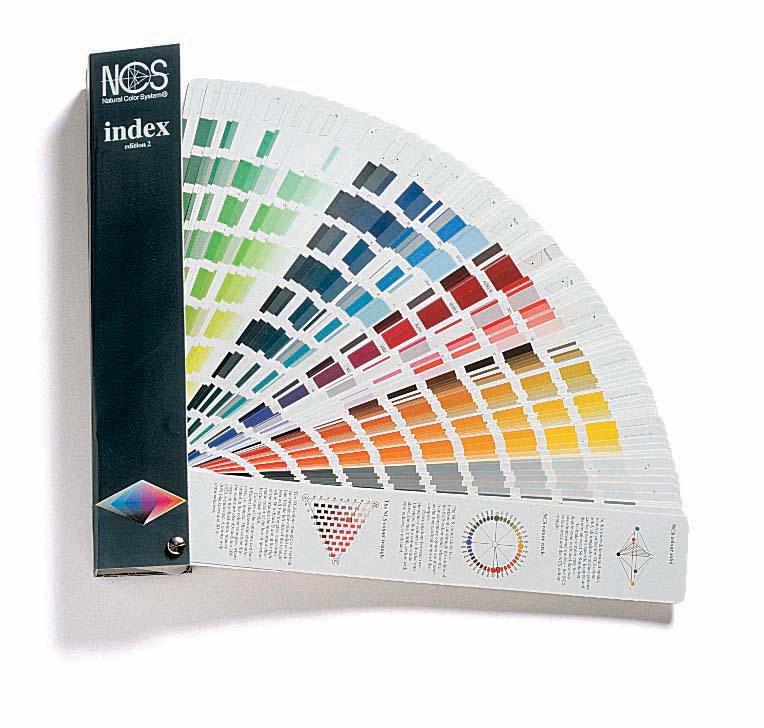
As research continued, the selection of standardised colours has been revised and expanded. To better serve professionals, NCS Colour continually expanded and improved its design tools to include more relevant standard colours. These additions are always market-driven and developed in close collaboration with the industry. The launch of the NCS Index in 1982 made the entire colour range more accessible than ever before, offering a portable fan deck format that quickly became one of the most popular and widely used NCS tools.
1,750 Standard Collection
The second edition of the standardised NCS colour samples was launched in 1995, featuring 1,750 colours. This edition brought about a world-leading colour accuracy and consistency that is still unique today, introducing unmatched colour accuracy and consistency, with samples marked with an “S” as in standard colour infront of the NCS Notations. It was also based on environmentally approved pigments in accordance with EU regulations.
1,950 Standard Collection
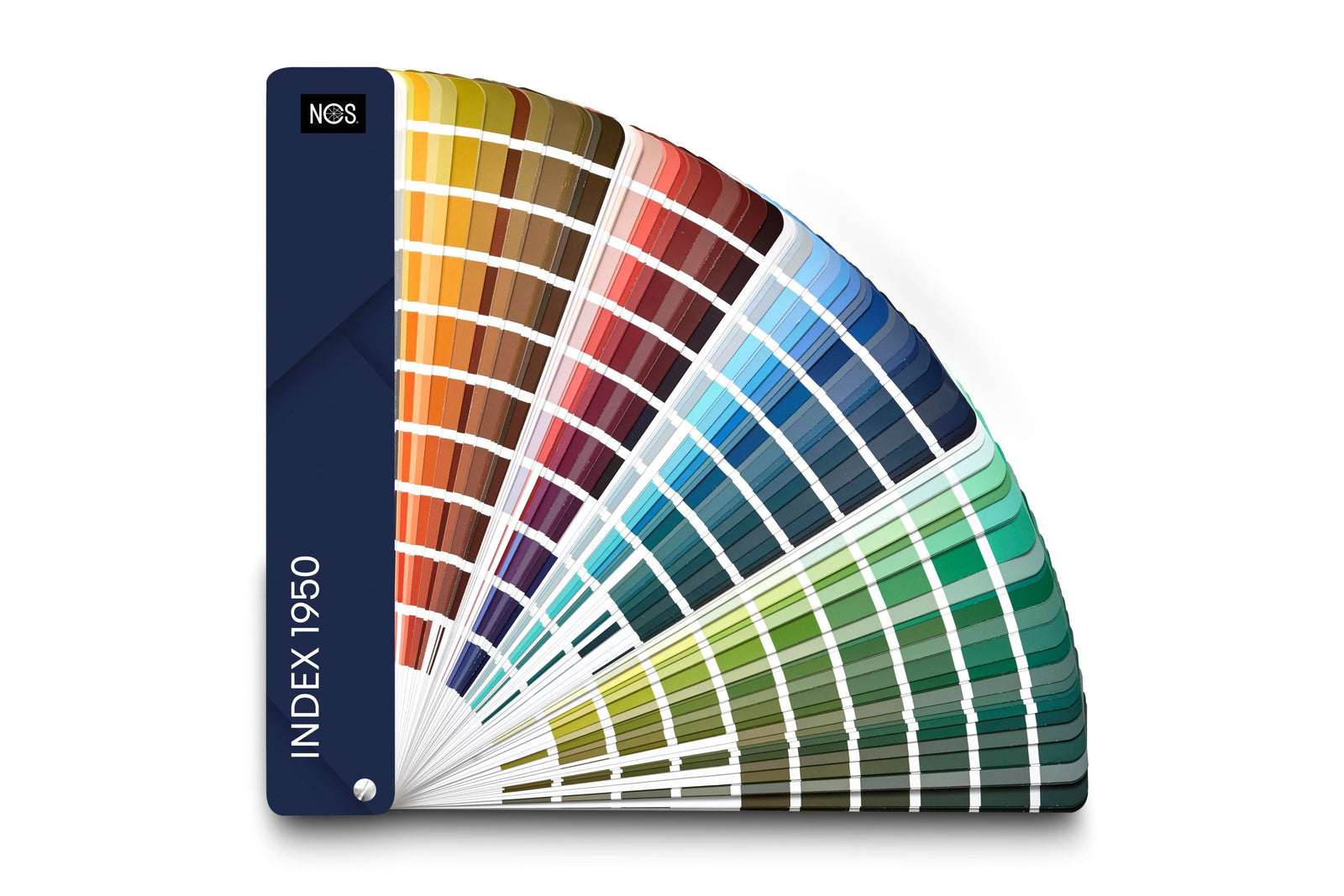
In 2004, 200 new colours were added, 184 light colours and 16 in the blue–green space, expanding the NCS Standard collection to 1,950 colours.
2,050 standard collection
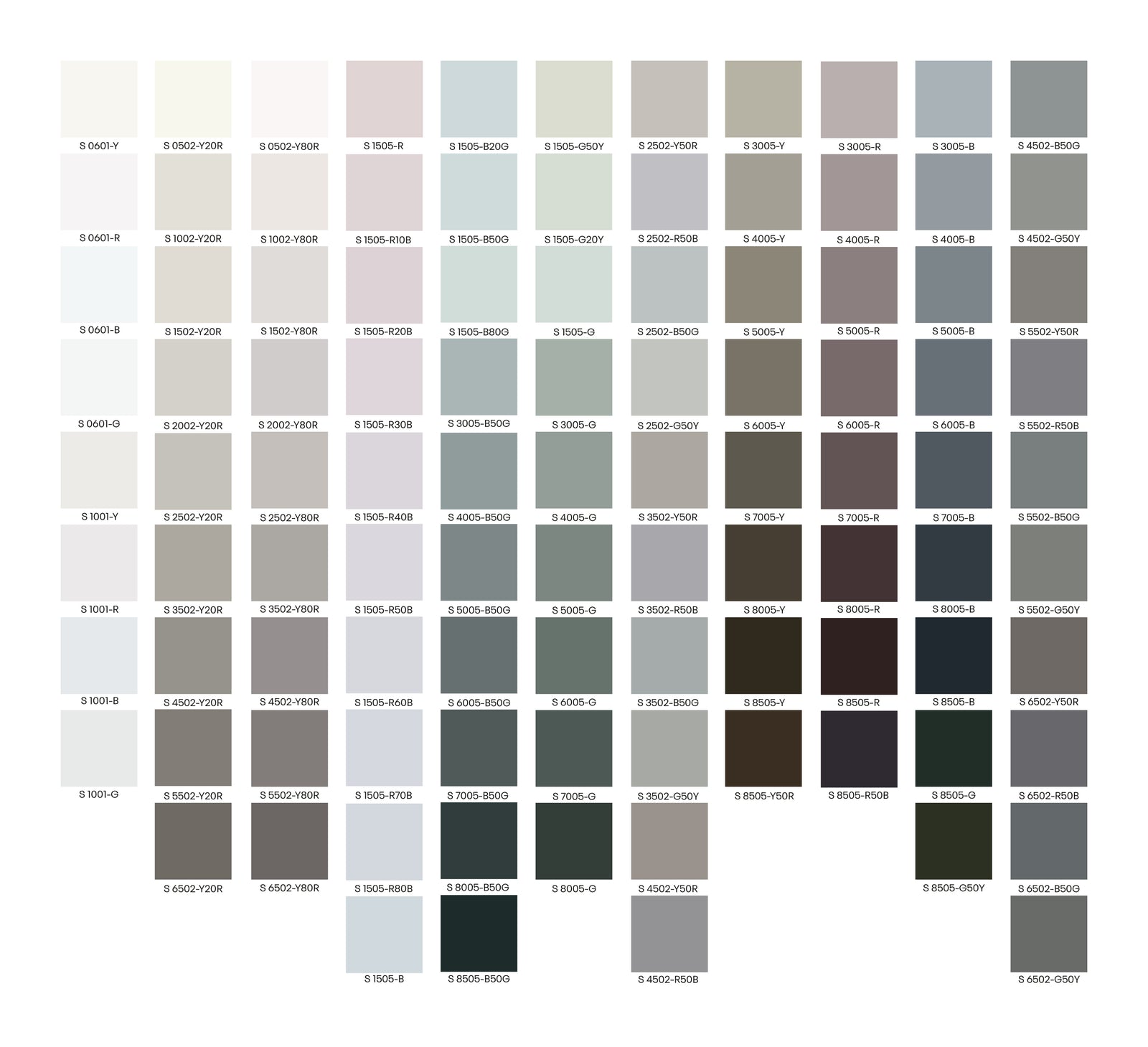
The latest update came in 2022, when the NCS Standard Collection was extended with 100 new standard colours, expanding the range from 1,950 to 2,050 standard colours. These additions focused on the low-chromatic colour spectrum to make colour selection easier, especially for white and greige tones.
More from NCS Colour's 80 year anniversary
Discover the anniversary celebrationTogether in colour, bringing together voices from leading companies from across industries, showcasing the diverse ways which colour creates impact and drives strategy, innovation and creativity.